
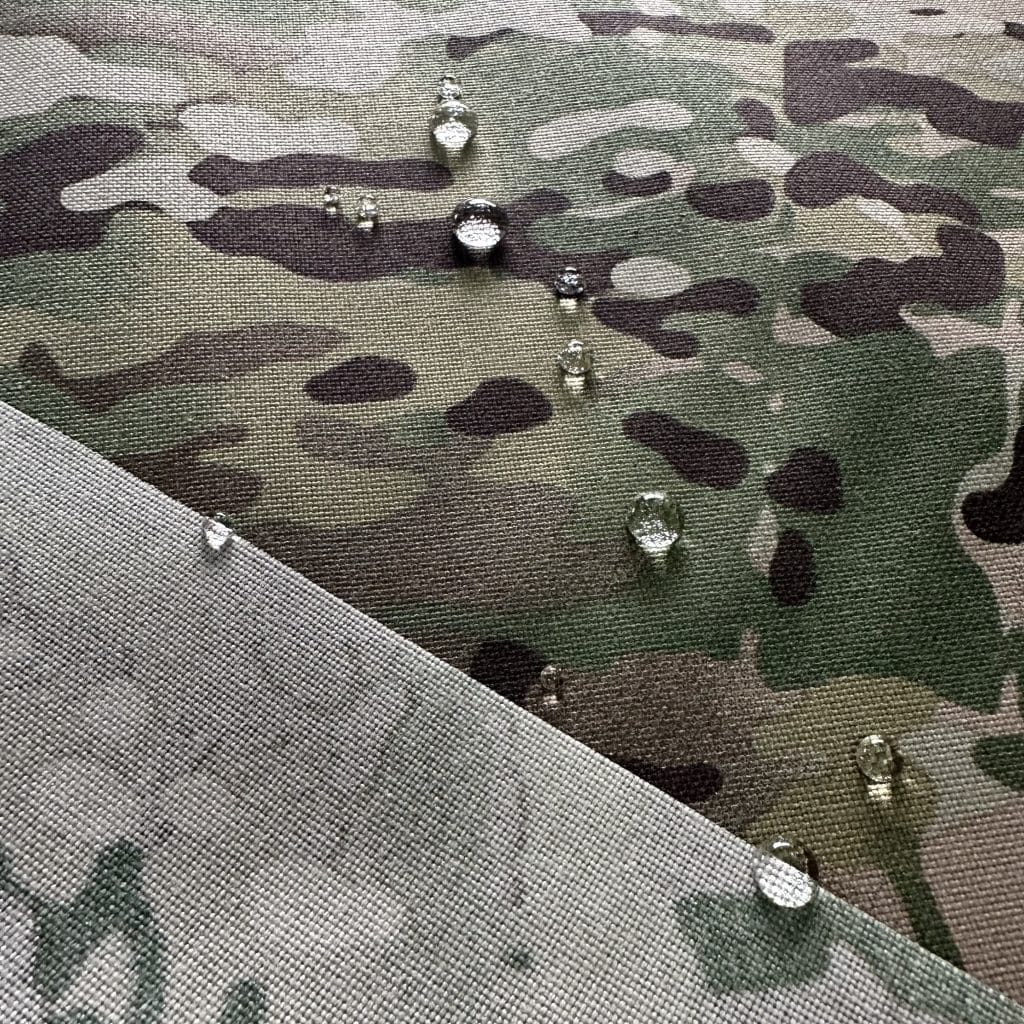
What Is IRR Multicam Fabric—and Why Tactical Gear Brands Specify It?
When you see “IRR Multicam” on a fabric specification, it’s not just marketing language. For many tactical brands and procurement teams, IRR (infrared reflectance reduction) is a functional requirement that affects whether a product is suitable for certain professional environments. At the same time, Multicam-style camouflage is one of the most recognized patterns in the tactical world—popular across backpacks, pouches, protective gear, and field covers.
But here’s the sourcing reality: not all camouflage prints are equal, and not all “IRR” claims are consistent. If you’re developing tactical gear, plate carriers, military bags, or rugged covers, you’ll want to specify the material and finishing in a way that reduces risk—risk of shade mismatch, coating failure, or inconsistent IR performance.
In this article, we’ll break down what IRR and Multicam mean from a practical buyer perspective, and how a 1000D nylon + waterproof PU coating + IRR Multicam construction can fit demanding gear applications. We’ll reference a proven spec as an example:
Nylon 1000D Cordura Fabric with Waterproof PU Coating – IRR Multicam Camouflage.

1) IRR: what buyers actually mean by it
IRR is commonly requested for tactical textiles because near-infrared visibility can matter under certain observation conditions. In procurement terms, “IRR fabric” often means the finished fabric is engineered to help reduce unwanted infrared contrast compared to standard dyed fabrics.
What matters in real sourcing:
-
Consistency: IRR performance needs to be repeatable between lots.
-
Color control: A camouflage pattern can look correct to the eye but still vary in IR behavior.
-
Compatibility with coatings: Waterproof PU coatings, printing, and IRR requirements need to work together—not fight each other.
If you’re a brand, the safest approach is to treat IRR as a measurable performance requirement, not just a label. Always confirm by sample and your test standard.
2) Multicam camouflage: more than “just a print”
Multicam-style camouflage is complicated because it is:
-
Multi-color
-
Pattern-sensitive (repeat size, alignment, sharpness)
-
Highly dependent on dye/print control
For your production team, the print must stay stable across reorders, otherwise you’ll get:
-
pouch panels that don’t match bag bodies
-
accessory items that look “off”
-
inconsistent color tone in the same batch
So when sourcing Multicam-style textile, don’t only ask “can you do Multicam?” Ask:
-
How stable is the shade matching across lots?
-
Do you provide lab dips / strike-offs before bulk?
-
How do you control print clarity and edge sharpness?
3) Why 1000D nylon is still a go-to for hard-use gear
Tactical equipment often fails for boring reasons: abrasion, tearing, and seam blowout. Many gear makers still choose 1000D nylon for areas that see heavy wear because the fabric offers a strong balance between:
-
durability
-
stiffness/structure
-
sewing reliability
-
long-term abrasion resistance
A reference construction that’s commonly used in rugged gear is 100% nylon, 1000D×1000D, with a structured weave and durable finishing. For example, this product spec lists 100% nylon, 1000D*1000D yarn count, 14×11 density, 340 gsm weight, and 150 cm width, with waterproof PU coating + IRR Multicam camouflage finishing.
4) Waterproof PU coating: where it helps (and where to be careful)
PU coating is widely used to provide water resistance and structure. For tactical gear, it’s often used because it can:
-
reduce water absorption
-
add body/stiffness for better shape retention
-
help resist contamination and dirt intrusion
However, you should still confirm:
-
coating adhesion quality (delamination risk)
-
flex performance (cracking at low temperature or heavy folding)
-
compatibility with your sewing process (needle holes + seam sealing approach)
5) What performance numbers should you look at?
A professional buyer should always ask for a TDS and pay attention to:
-
tensile strength
-
abrasion resistance
-
color fastness (rubbing + washing)
-
dimensional stability after washing
-
water repellency tests (if provided)
In the referenced TDS, the fabric lists tensile strength warp 2400 N / weft 1700 N, abrasion resistance >100,000 cycles, color fastness to rubbing dry 3–4 / wet 3–4, color fastness to washing 3–4, washing size change 2%, and spray test 4.
These numbers aren’t just “nice to have.” They help you predict:
-
whether a bag base will survive concrete abrasion
-
whether a plate carrier will fray at edge binding points
-
whether printed camouflage will rub off during use
6) Ideal applications for IRR Multicam + PU coated 1000D nylon
This type of fabric is commonly used for:
-
military backpacks and field bags
-
tactical pouches
-
protective covers
-
vests and load-bearing equipment
The product page explicitly lists usage such as military bags, bulletproof vests, and covers, and notes packaging by roll and production time 10–15 days after sample confirmation.
7) How to write a safe purchase specification (copy/paste template)
Here’s a practical buyer spec format you can use in your inquiry:
Base Fabric
-
Material: 100% nylon
-
Yarn count: 1000D × 1000D
-
Construction/density: 14×11
-
Weight: ~340 gsm
-
Width: 150 cm
Finishing
-
Back coating: waterproof PU
-
Face: Multicam-style camouflage print
A proven reference spec is available here:
Nylon 1000D Cordura Fabric with Waterproof PU Coating – IRR Multicam Camouflage.
Testing (recommended)
-
Abrasion resistance target
-
Tensile strength target
-
Color fastness (rubbing/washing)
-
IRR performance testing to your standard
8) Avoiding common sourcing mistakes
Mistake 1: approving by photo only
Camouflage must be approved by strike-off/sample under controlled light.
Mistake 2: not locking the standard
For repeat orders, lock your standard: color reference + print file + coating type + test method.
Mistake 3: ignoring the coating side
PU coating quality decides whether you get cracking, peeling, or early failure.
FAQ
1) What does IRR mean in tactical fabrics?
It usually refers to reduced infrared contrast or controlled IR reflectance behavior. Confirm performance by your test standard.
2) Is Multicam print the same from every supplier?
No. Shade, clarity, and repeat stability vary. Always approve by strike-off and lock the standard.
3) Why choose 1000D nylon for tactical bags?
Because it balances structure and durability, especially for abrasion-heavy zones.
4) Does PU coating make fabric waterproof forever?
It improves water resistance, but durability depends on coating quality, thickness, and use conditions.
5) What’s a good abrasion target for hard-use bags?
It depends on the product category, but higher cycle ratings generally indicate better durability. The reference fabric lists >100,000 cycles.
6) Will the print rub off over time?
It depends on print method and finishing. Check rubbing fastness and confirm by sample.
7) What width is common for production?
150 cm is common for cutting efficiency; the reference spec uses 150 cm.
8) How fast can bulk production be done?
For this product, production time is listed as 10–15 days after sample confirmation.
Call to Action
If you’re building a tactical product line and need stable Multicam matching + waterproof PU coating + IRR finishing, request a free sample and full TDS using the product link below:
Nylon 1000D Cordura Fabric with Waterproof PU Coating – IRR Multicam Camouflage
Contact Us for a Detailed Offer:
Company: Lean Textile Co., Ltd.
Website: https://www.safety-lean.com/
Email: [email protected]
WhatsApp / WeChat: 008615051486055